HERITAGE OPEN DAYS 2017: “LET ALL BY-PASSES BE BYGONES”

With the theme for this year’s Heritage Open Days focussed on “Wheels in Motion”, this article looks back to a controversy that placed Dorking in the national spotlight as the town sought to cope with the impact of an ever-increasing use of motor vehicles.
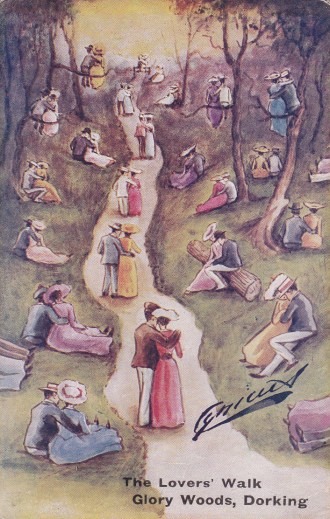
Photo 1 Lovers' Walk
Photo 1.  “The Lovers Walk”

Dorking’s Glory

For years the Glory Woods had formed part of the Deepdene estate, linked to the grounds of the mansion by two private bridges passing over Chart Lane.  These woods on the hills to the south above the town were always held in great affection by townsfolk.  Indeed, if the nickname given to St. Paul’s Road East of “Sweetshearts Lane” and the humorous postcard by ‘Cynicus’ are to be believed, the venue was also immensely popular with local courting couples!

The Gift

In November 1927 the Duke of Newcastle, Lord Francis Hope once owner of the entire Deepdene estate, gave notice that he intended to gift the woods to the town in celebration of his son Lord Lincoln’s coming of age.

Arrangements were put in hand for a ceremony at a “thanksgiving meeting” on Sunday 28th July 1929.  Bills announcing the event had been printed and posted

around the town, a band had been engaged, schoolchildren taught hymns and councillors had speeches prepared.
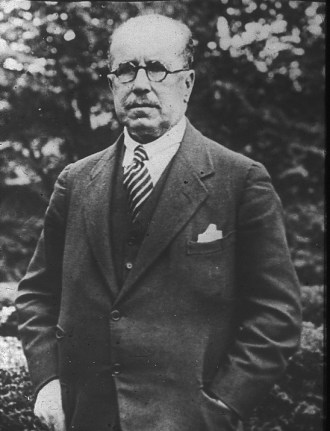
Photo 2 The Duke of Newcastle 1866-1941
Photo 2: The Duke of Newcastle

 The Upset

Just days before the gathering, the Council received a letter on 25th July with the Duke announcing the intention to withhold the gift. That sudden decision and the controversy that ensued was quickly picked up by national newspapers.

The cause of this upset was the proposed “Dorking By-Pass”, part of the County Council’s intended road improvements. Nine route options were discussed, eventually narrowed to three.  One, took the new by-pass up the Ashcombe Road, over Sondes Place, through the Nower and then roughly parallel with Ridgeway Road to North Holmwood. .  It had the advantage of using agricultural land and requiring no demolition.  Another route considered utilising Punchbowl Lane but there were difficulties in cutting that road and it was deemed impractical.

The third, most direct route was to follow the current line of the A24, straight up Deepdene Avenue but then on through the very recently laid-out housing in the Deepdene grounds, constructed when the mansion and gardens were sold a few years earlier.  Unsurprisingly, there were many protests that this route would violate a “first class residential district”, requiring that “gardens and residences would be forfeited and the road bought within feet of homes”. In a letter to “The Times” the Duke spoke of the “mutilation of the Glory Wood”.

 The Town’s Choice

All the options were debated. As Colonel Barclay of Bury Hill allowed public access to the Nower a meeting attended by 800 ratepayers opposed the “western” option through his parkland by 369 votes to 196.  The Duke accused the local

Council of “dirty tricks” and the council members “while smarting under the indignity of the position” voted to put the Glory Wood by-pass route on the map. In 1931 a

Ministry of Transport enquiry confirmed the Deepdene route with the compulsory purchase of two acres of the Glory Wood plus other land.  The Duke commented that “naturally I feel hurt that Surrey County Council should take a slice off and utterly destroy the beauties of Chart Lane – a lovely lane”.

Photo 3 Chart Lane (A)
Photo 3: Chart Lane

Whilst no doubt still seething about the route, the Duke’s gift was finally completed in October 1929 when his agent handed to the Council the deeds with a letter describing how “In making this gift was my intention to do my best to preserve for Dorking in perpetuity one of the beauty spots in its immediate vicinity, but the proposed by-pass will not only take a slice off the Glory Woods, it will completely destroy one of the lovely lanes for which Surrey is famous”. At the Duke’s own request there was to be no public ceremony. The following day the assembled councillors voted a unanimous resolution thanking the Duke for his “generous gift, not only to the town but to the nation”.

Photo 4 Construction of the By-Pass
Photo 4.  “Construction of the By-Pass”

Construction Begins

The building of the road commenced in 1931 with an estimated cost of £102,250, employing hundreds of men, half of whom came from distressed areas of the country. Homes were demolished, front gardens were cut away and the Deepdene Hotel faced with the prospect of a busy road cutting directly through the grounds very close to the mansion.

The Dorking by-pass was completed early and opened without ceremony on 2nd June 1934 to accommodate the traffic attending the Derby.  “The Times” reported that “two thousand rhododendron bushes and thousands of other bushes and trees”

had been planted guided by the advice of the Roads Beautifying Association. It was claimed “that in a few years time this will be the most beautiful arterial road in the South of England”.

 “Let all by-passes be bygones”

However, even as late as 1934 the by-pass decision still rankled with the Duke, who wrote, “I have deeply resented the fact that the people of Dorking did not oppose the spoiling of Chart Lane and the hacking away of part of the Glory Woods, which I made a free gift of to the town.  It was a dirty trick on the part of the Urban Council to accept the gift on the 8th April 1928 when they must have known on that date of the projected scheme”.

That same year at a meeting of the Urban Council it was reported that the chairman “Major Chance appealed to the Duke as a sportsman to withdraw his allegation against Dorking and he ended with the fervent wish “that we should let all by-passes be bygones”.”

Photo 5 The new By-Pass at the junction with Chart Lane
Photo 5:  “The new By-Pass at the junction with Chart Lane”

Researched by a Dorking Museum volunteer

Main sources:
“The Times Digital Archive 1785 – 2011”
Dorking Museum archives  

Photographs are reproduced by kind permission:
No. 1 Private Collection;
Nos. 2 – 5 Dorking Museum collection.


Hopelessly in Love

It was at “Delmonico’s” restaurant in New York in 1892 that the dashing aristocrat, Lord Francis Hope, owner of the Deepdene estate, met and fell hopelessly in love with a star of the American stage, May Yohé.

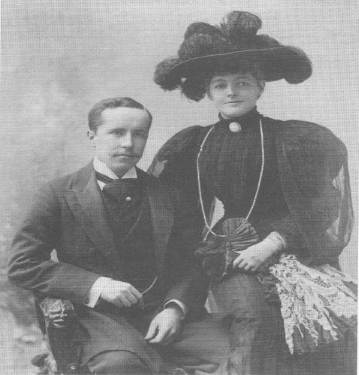
May and Lord Francis
Lord Francis and May as a young couple. From the John Culme Footlights Collection.


Money and Marriage

A pretty singer and actress, May Yohé’s arrival in London only deepened Lord Francis’ infatuation. Already spending the wealth of a vast fortune, that included the fabulous Hope Diamond, in an extravagant, irresponsible way, Lord Francis unwisely began financing ventures to advance May’s career. Inevitably, bankruptcy loomed for the owner of the Deepdene estate despite his being heir to a dukedom.

“He’s Hope, and it’s a cinch he has faith, seeing he married Yohe and she hasn’t a dollar in the world; so I guess it’s a case of Faith, Hope and Charity”
George Bernard Shaw, quoted in R. Kurin, 1950, Madcap May

Before long the press was speculating that the couple might marry, prompting his Lordship’s family to absolute horror at the prospect – with their reputedly offering him £300,000 if he would break off the relationship. Nevertheless, Lord Francis proposed, May accepted, and in 1894 they were married. He was to spend a part of their honeymoon, however, attending the bankruptcy court.

Musical May

May epitomised the naughty nineties
R. Kurin, 1950, Madcap May

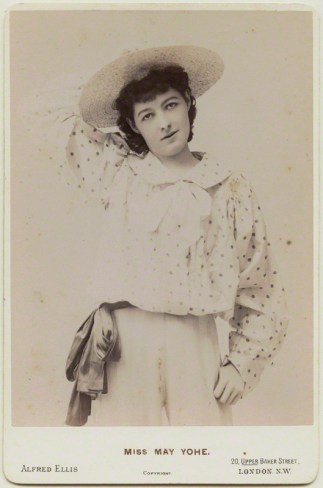
May Yohe
May Yohe as Little Christopher Columbus, by Alfred Ellis, 1893. Copyright National Portrait Gallery, London

Still at the height of her career May Yohé, now Lady Francis Hope continued to act and sing in sensationally popular musicals both in Europe and the USA. The Hope family wanted nothing to do with her. May was deliberately snubbed by society ladies when attending events but this was said to have changed dramatically when the playboy Edward, Prince of Wales, took an interest in her – as he did with numerous female performers.


A ‘Second Honeymoon’

By 1899 there were newspaper reports of a failing marriage and separation. Despite still living well beyond their means the couple embarked on a world tour. A ‘second honeymoon’ it was said but it was perhaps equally a way to escape his creditors. The state of their finances was so poor that May, on engaging to perform in New York the next year, had to do so with the embarrassing stipulation that Lord Francis appear in the theatre lobby, to be seen by theatre-goers as they arrived and again during the interval!  The marriage, her career and his finances were unravelling at an alarming rate.

The most handsome man in the Army

captain-putnam-bradlee-strong
Captain Putnam Bradlee Strong. Copyright Brown Brothers.

On the return voyage to Southampton they encountered fellow passenger US Army Captain Putnam Bradlee Strong; described as “the most handsome man in the Army”. Before very long “New York’s finest lover” was wooing May. Lord Francis seemed oblivious but, in truth, he had appeared to be showing very little interest in May perhaps even encouraging the outcome.


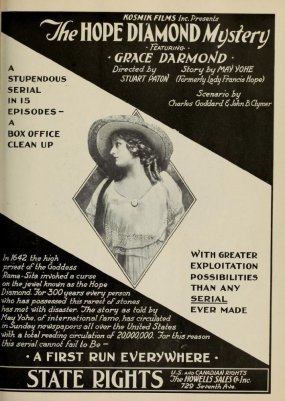
By 1901 the marriage was over, an infatuated Captain Strong resigned his army commission to be with May. She finally, very publically, deserted Lord Francis, who sought divorce in 1902 to be rid of his “giddy and unfaithful wife”. No sooner than the divorce was finalised, May married Putnam Strong but it was to be yet another doomed relationship. Her stage career staggered on with performances trading on her being “the former Lady Francis Hope”. She had a role in the 1921 silent film The Hope Diamond Mystery, “A story by May Yohé”, that probably magnified the rumours of the diamond curse to their current level of fame.hope-diamond-mystery-poster

The final fall

May remarried several times and attempted various unsuccessful money-making ventures until ending her days on hard times, having to work as an office cleaner and a clerk. When she died in 1938 her ashes were scattered in the Atlantic Ocean.  Had things turned out differently, she might have become the Duchess of Newcastle.

Lord Francis remarried happily to Olive Muriel Thompson in 1904 and inherited the title, Duke of Newcastle in 1928 but by that time had already destroyed much of the family wealth and estates through enforced sales to meet his debts. The once magnificent Deepdene had never been the real residence of unlucky Lord Francis but had been rented out, its wonderful collections of sculpture and art sold off and the wider estate broken up and sold to pay off his debts. Even the Hope Diamond was sold. The Duke was to finally return to Deepdene, however, when he died in 1941 and was interred in the Hope Mausoleum.

hope-mausoleum-july-16
The Hope Mausoleum on the Deepdene Trail.


Researched by a Dorking Museum volunteer

Find out more
Watch some episodes of May Yohé’s Mystery of the Hope Diamond!
https://www.youtube.com/watch?v=oQalu12S9Cg

Key Source
Kurin, R. 1950 Madcap May: Mistress of Myth, Men and Hope London: Smithsonian Books
'Every reasonable effort has been made to trace copyright of the images used but the Deepdene Trail project will  welcome any information relating to the copyright ownership  of any unattributed material shown.'

Re-discovering Deepdene’s historic paths

From 12th of December 2016 we began work to resurface two more historic paths on the Deepdene Trail to help visitors find their way and get around. The paths had been opened by hand earlier this year by the hard work of the Friends of Deepdene.

Early Deepdene paths

From its earliest times there has been a path network throughout Deepdene that has encouraged visitors to explore.

In 1653 when Charles Howard became owner of the estate, Deepdene mainly consisted of the deep valley at the heart of the grounds that are the Gardens of Deepdene today. He created there, over the next 20 years, one of the first truly Italianate Gardens in England. This ambition was greatly supported by the steep sides of the valley into which he cut paths creating Italian-style terraces in the manner of a theatre.

Sir Charles has shaped his valley in the form of a theatre with more than six narrow walks on the sides, like rows of seats, one above the other. . .’

John Aubrey describing his visit to Deepdene in 1673

The Hope family’s path network

In 1807 Thomas Hope became Deepdene’s owner followed by his son Henry Hope in 1832 and it is from their time that the main paths of the Deepdene Trail were formed.

‘Here I was much gratified with a pleasing picture of landscape-gardening; the quiet of echoing dells; and the refreshing coolness of caves and subterranean passages, all which combined to render this spot a kind of Fairy Region. Flower- gardens, laid out in parterres, with much taste, here mingle the aspect of trim neatness with rude nature, in walks winding though woods and plantations and containing several ruined grottoes and hermitages, well adapted, by their solitary situations, to study and reverie.’

Timbs, 1822, describing Thomas Hope’s Deepdene in A Picturesque Promenade Round Dorking

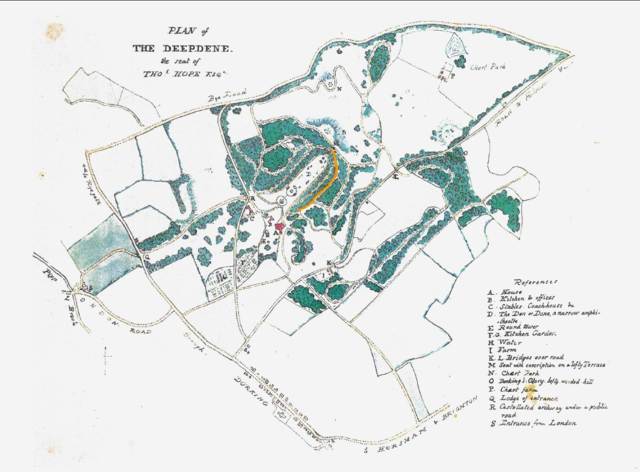
The first path we are resurfacing formed a ‘serpentine’ walk through the woods that linked the Gardens to the Terrace. This drawing from 1825 shows the first version of this path in Thomas Hope’s time.

Deepdene_map_1825
Early path highlighted on map from Britton, J. 1826 Descriptive account of the Deepdene, the Seat of Thomas Hope Esq. © Reproduced by kind permission of the Lambeth Archives department

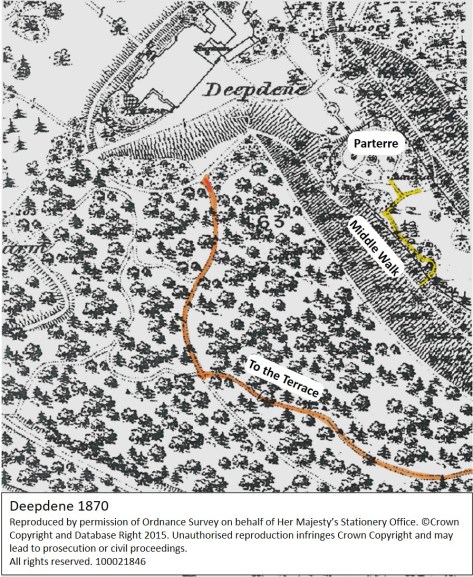
When Henry took over he completed this route. He also added a new path linking the parterre – the formal garden area that has always been a feature of the gardens at Deepdene – to the Middle Walk.

deepdene_paths_1870

These paths remained throughout the Deepdene, playing host to visitors such as Winston Churchill who came to see his aunt, the Duchess of Marlborough, when she rented the estate at the turn of the 20th century. Later they entertained guests of the Deepdene Hotel in the 1920’s and 1930’s. As the estate was broken up and the House repurposed as headquarters for the Southern Railway (1939-1966), however, many started to become less cared for and overgrown.

This slideshow requires JavaScript.

Friends of Deepdene

This year these two particular paths were uncovered by the Friends of Deepdene. The volunteers worked with us to locate and map out these historic routes then by hand they cut through the overgrowth revealing the routes we use today. Thanks to their hard work we can now relay the surface onto these paths allowing visitors to get around the Trail with more ease and follow these historic routes like visitors did in the past.

Join us!

Would you like to join the Friends on site and get involved in work like this? They currently work two days every week (Wednesday-Thursday). If you are interested in conserving this fantastic historic landscape, looking for a bit of regular exercise or are a dab hand with a pair of secateurs and willing to lend a hand, we would be delighted to hear from you. Please contact:

thedeepdenetrail@molevalley.gov.uk

‘A perfect way to spend Sunday morning’- walks, talks and Trail activities

Since the Grand Opening we have been delighted to see many visitors exploring and enjoying The Trail activities such as seasonal trails, walks and talks. We have also been pleased at the useful feedback received so far that will help us improve the Trail as the project continues for its second year – a year full of more fun events and activities!

Halloween Hunt

Throughout October half-term this year we ran a Halloween hunt. Nine spooky skeletons crept into the gardens of the Deepdene Trail. Families hunted them down and used the letters they held to discover the name of one of Deepdene’s treasures. Many visitors then headed back to Dorking Halls Café to collect Halloween treats.

“Fun Halloween trail for kids, lots of informative boards about the history of the site, and space for kids to explore and enjoy the woodland and wonderful views from the Terrace. Full credit to all the local volunteers who have been involved in creating, promoting and maintaining the Trail!”

Visitor to the Trail

Dorking Museum guided walks

Dorking Museum have taken on delivery of fantastic guided walks of The Trail since the opening in September. Visitors can book on an advertised public tour or book a private group tour. The dedicated volunteer walk leaders guide visitors from The Trail entrance through the Gardens, up the Terrace and for an exclusive look inside the Hope Mausoleum illustrating the walk with stories from Deepdene’s past.

Commonly fully booked, the next tour will visit the Deepdene on January 8th 2017 – book your place now!

museum-guided-walks
Dorking Museum volunteer leading visitors into the Hope Mausoleum.


Talks

We have been spreading the word about The Trail through talks to groups and societies such as the Friends of Holmwood Common, public talks hosted generously by Dorking Library, and inspiring others to give talks based on Deepdene’s history.

img_20161122_173630
Talk at Dorking Library


Walk for Health Christmas Special

27th November 2016 we embarked on a seasonal celebration of healthy walks on the Deepdene Trail with Mole Valley’s Walk for Health Coordinator Estelle Holmes. Families joined us for a frosty Sunday morning walk of the Trail with a few facts thrown in by Activity Coordinator Gail and a chance for the little ones to try out the Trail’s new Winter Woodland Bingo. It was a great success ending with delightful drinks, mince pies and craft activities for the kids at Dorking Golf Club.

“A perfect way to spend Sunday morning and even the weather cooperated!  Gail was so knowledgeable it added another dimension to a trail we had already explored a little and she balanced giving information in an interesting way with the need to keep on the move. The refreshments at the Golf Club were a perfect finish to the morning. . . with lovely activities for the younger ones to enjoy while mums and dads had a few minutes of peace.”

Visitor to the Trail

Why not try our Winter Woodland Bingo for yourself? Visit our website to download the bingo sheet and have a go!

The Deepdene Trail is now open!

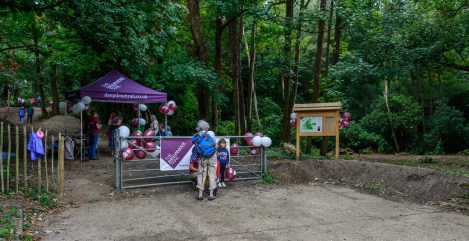
Saturday 10th September we opened The Deepdene Trail to the public for the very first time on our Grand Opening Day!

Due to open at 10am, eager visitors, dressed for the predicted rain were at the entrance looking for maps and guidance by 9.15am. Our amazing volunteers who had given up their Saturday to help out were on hand to welcome them as we put finishing touches on our decorations.

entranceVisitors’ enthusiasm throughout the day kept smiles on all our faces as we ignored the rain and laid on music, face painting, guided tours and story telling.
This slideshow requires JavaScript.

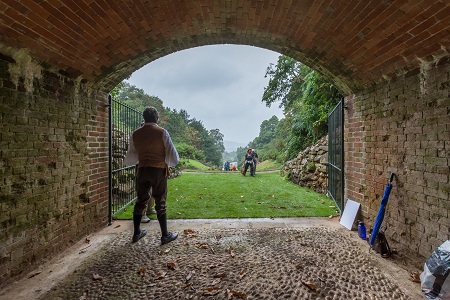
Costumed actors brightened up the Gardens and local artists recreated the views from the Terrace.grotto-view

The young winners of our Children’s Art competition ‘My Dream Garden’ were on hand to accept their prizes from our partners, the Dorking District Fine Arts Society, as their works of art went on display at Dorking Halls.

Over 200 visitors slogged through the storm to visit the freshly restored Hope Mausoleum specially open for the event and admire the Thomas Hope inspired settee on display inside.

inside-mausoleumOver 500 people arrived on the Trail during the day to discover and explore.  They were greeted by our fabulous, enthusiastic volunteers – if you are one of them a huge thanks to you!
The day was a huge success, feedback has been enormously positive, The Trail is getting good media coverage and many more activities are planned for the coming year.

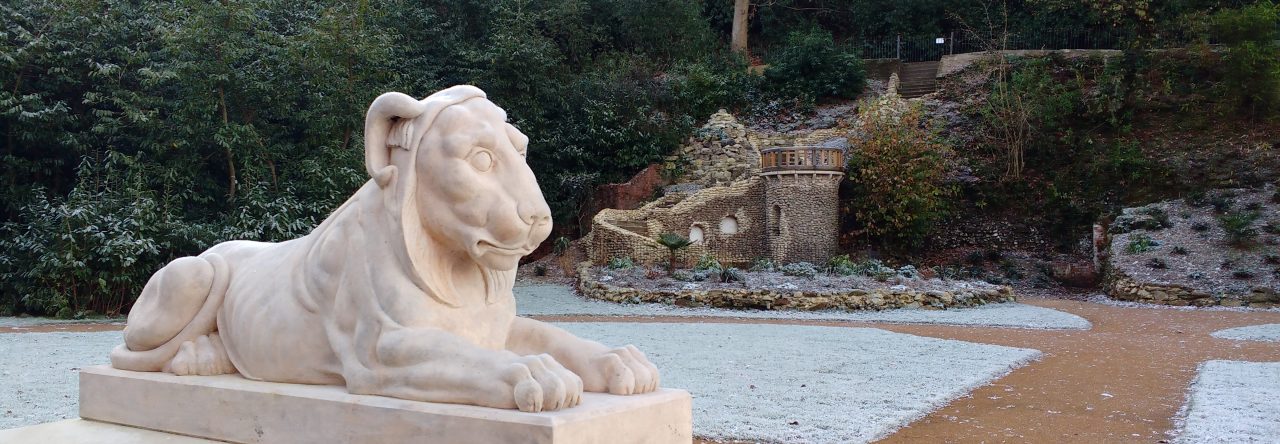
The Partner’s Private View on Friday was attended by over 120 people who listened to Lord Fellowes of West Stafford describe Thomas Hope’s accomplishments and declared the Trail open by revealing our new Coade stone lion in the centre of the Deepdene estate Gardens.

This slideshow requires JavaScript.

If you haven’t visited The Trail yet then do see www.deepdenetrail.co.uk , download the new App or pop by the Council Offices to pick up a map.

Deepdene Garden renovations begin – the Grotto

The exciting renovations at Deepdene Gardens began last month.

Universal Stone expert stonemasons have made great steps already in works on the key architectural features of the Deepdene Gardens – especially the Grotto.

The Grotto – background

The Grotto at the top of the Gardens began life as a failed tunnel into the hill ordered by then owner of the Deepdene, Charles Howard in the 17th century. The intention was to tunnel through the hill to the far side to enjoy the views; however the sandy soil led to a collapse. Howard kept the entranceway and turned it instead into a Grotto with flint lined archways.

In Thomas Hope’s time this simple Grotto was extravagantly restyled. The flint was covered with brick and render interiors with small alcoves for statues, a decorative balustrade was erected above the vault and a statue of the Egyptian God Seti took pride of place.

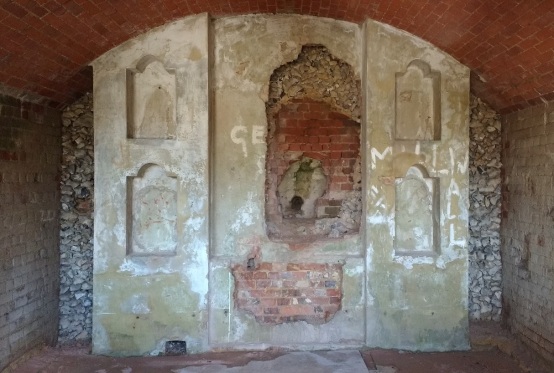
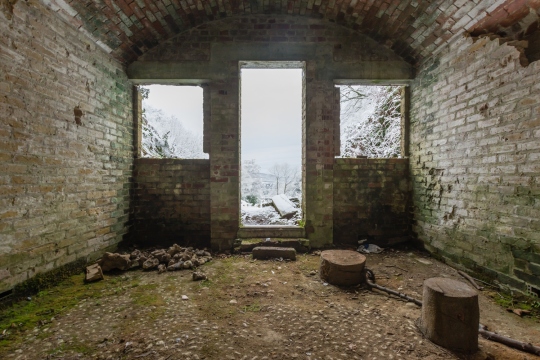
In WWII the decorative area was repurposed probably as an ammunition store. The statues had been sold years before and the military installed new interior walls and frontage to contain their supplies.

grotto 1
Interior of Grotto, Jan 2016. Photography with thanks to Alex Lyons.
grotto 2
Exterior of Grotto, Jan 2016. Photography with thanks to Alex Lyons

The Grotto – repairs

Universal Stone began work to return the Grotto to how it looked in Thomas Hope’s time by first recovering the broken remains of the stone balustrade.

grotto 3
Recovered stone balustrade

This remaining stone will be repaired and integrated into a replacement that will once again line the top of the vaulted Grotto. The vault itself was completely uncovered for assessment giving us a glimpse at the original structure.

grotto 4
The exposed vault of the Grotto

Leaf litter was dug away from the exterior allowing us to see the extent of original walls and identify how far the balustrade extended to.

The WWII brick work has been recorded and carefully removed from the inside and from the entrance recreating the classic view of the Grotto as it was in Hope’s garden.

grotto 5
The exposed interior of Hope’s Grotto.

The remaining stone is being sensitively repaired and we will keep as much of the 19th century fabric as possible.

The main structural work will be complete by the end of June and the garden renovations will be ready for visitors in September – we can’t wait!

Children’s ‘My dream garden’ art competition launched

Design your own Dream Garden

This week we launched our children’s art competition ‘My Dream Garden’ in partnership with Junior Youth Voice. We have challenged the young people of Mole Valley to help us celebrate the opening of The Deepdene Trail in Dorking on 10th September by designing their own Dream Garden.

There have been gardens in Deepdene for over 300 years and each owner dreamt up their own new styles for the garden. One famous owner, Thomas Hope, added a Temple and statues of Egyptian Gods and lions. We look forward to seeing what exciting new designs our competitors come up with.


Judging, Winners & Prizes

Entries will be judged by a panel including representatives from Youth Voice, Mole Valley District council and a local artist.

There will be 3 winners chosen from each age group: 4-7yrs, 8-11yrs and 12-16yrs.

A special prize will be given to the School who sends in the most entries.

All 9 winners and a representative from the winning school will be invited to attend the Grand Opening of The Deepdene Trail on 10th September 2016 at Deepdene Gardens to receive their prizes.

Individual prizes have been sponsored by Dorking Decorative Arts Society as part of the 2016 Heritage Open Days celebration (www.heritageopendays.org.uk ). The 9 winning individual entries will also go on display at Dorking Halls from the 10th of September . They will also be featured online at www.deepdenetrail.co.uk .

How to enter

Do you know a budding artist? Then encourage them to draw/paint/create a collage or create on their computer their own Dream Garden design on an A4 or A3 sheet of paper.

Post or drop off the entry to:

My Dream Garden: The Deepdene Trail, Mole Valley District Council, Pippbrook, Reigate Road, Dorking, Rh4 1SJ Or email it to: thedeepdenetrail@molevalley.gov.uk

All entries must be received by 7th June 2016, please only enter one drawing.

Don’t forget to fill in your details: NAME, AGE, SCHOOL, ADDRESS, EMAIL, PHONE

For full T’s & C’s see our website http://www.deepdenetrail.co.uk or contact us at thedeepdenetrail@molevalley.gov.uk

This competition is run by The Deepdene Trail in partnership with Junior Youth Voice and Youth Voice. The Deepdene Trail is supported by the Heritage Lottery Fund.kids art1


Locals explore work on the new Deepdene Trail

Our second set of ‘behind the scenes’ walks for visitors revealed the recent changes to the Deepdene Trail as we prepare for it to open in September 2016. The walks were illustrated by stories from the past provided by Project Manager, Alexander Bagnall and Activity Plan Coordinator, Gail Mackintosh.

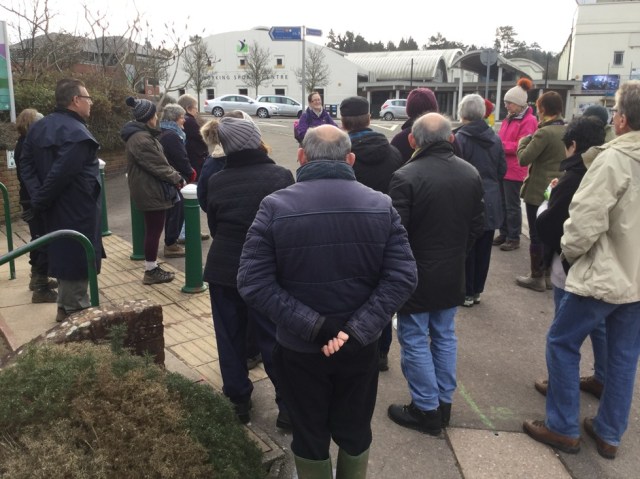
Both walks in February this year started with our visitors walking from the centre of town out across the Cotmandene to the Deepdene Gardens. Illustrated along the way with images and tales of the Deepdene’s owners’, Charles Howard and the hero of our project – Thomas Hope.

tour 23.2.16 7b

New Paths

The visitors were amongst the first to use the newly laid paths into the Gardens, currently still closed to the public without a project guide, as work vehicles continue to use the site. The location of the entrance mirrors the entrance way shown in early paintings of the Estate in the 18th century and the driveway used in the Hotel era of the House in the 1920s-30s.

tour 23.2.16 3
Visitors using the newly laid paths into Deepdene Gardens – not yet open to the public

Visitors were excited to hear about the new works about to start to repair the Grotto and Embattled Tower that feature prominently in the Gardens.


tour 28.2.16 2b
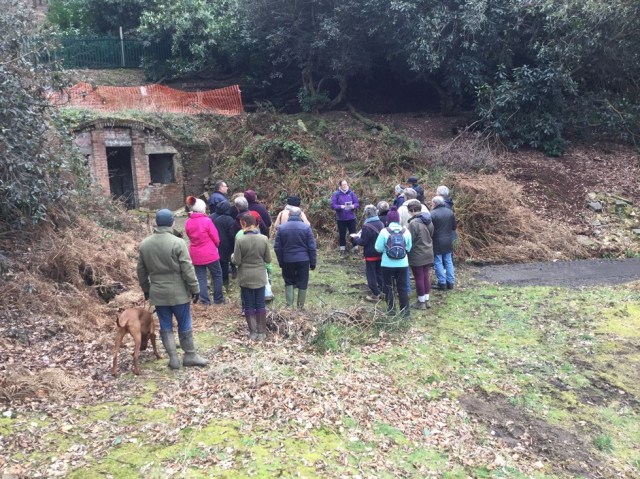
Visitors learn about the different phases of the Grotto’s history 


The Terrace

Our adventurous walkers were then first to use the new trail just opened up by our amazing volunteers – the Friends of Deepdene. The Friends had incredibly only taken a few weeks to reopen ancient routes up the hill to join the existing paths to the Deepdene Terrace. The views from the top were fantastic, one way looking down the flight of flint steps into the Gardens and the other taking in the fantastic panoramas of Chart Park.

tour 23.2.16 10b
Standing on the site of the now lost Temple on Deepdene Terrace.

The Mausoleum


From there an exciting scramble took us down to the Deepdene Trail’s hidden gem – the Hope Mausoleum. Visitors discovered the sad tale behind its construction in memory of Thomas Hope’s young son who died, aged only 7 and that Thomas Hope is himself laid to rest inside Mausoleum’s vaulted chamber.

The Mausoleum conservation work is almost complete with and the restored Mausoleum will soon be revealed.

Many thanks to our visitors for supporting the project and to our expert stone masons PAYE for letting us onto site whilst they worked.

We hope to arrange a special visit to the Mausoleum once it is complete. You can keep up to date by Signing up to the Deepdene Trail Newsletter and keeping an eye on our Facebook and Twitter accounts for updates.

Thomas Hope

The Deepdene Trail focuses on the Deepdene Estate’s owner in the early 19th century, Thomas Hope.

Hope recognised the potential of the Italianate style house and gardens created by earlier owner Charles Howard. Hope remodelled Deepdene’s house and lands connecting the two with striking features that remained for several generations and still resonate with what we see and appreciate today.

Early life

Thomas Hope was born in 1769 into a family of highly successful and influential bankers.   Thomas’ ancestor, Henry Hope, had emigrated from Scotland to Amsterdam and set up as a merchant in the second half of the 17th Century.  He had three sons who entered into the banking business and became very successful raising loans for the British government to fund the seven years war.

By 1762 the Hope & Company Bank had become Europe’s leading merchant bank with famous clients including the King of Sweden and Catherine the Great.  The family became the most powerful and wealthy in Holland and lived as royalty.

Thomas’s father John owned a number of large houses in Amsterdam, The Hague, and Country seats near Harlem and Utrect. John also had a prominent collection of paintings sculpture and antiquities which eventually became part of Thomas’s great collection.

NPG 4574; Thomas Hope by Sir William Beechey
Thomas Hope, by Sir William Beechey, oil on canvas, 1798, NPG 4574 Copyright National Portrait Gallery, London

Grand Tour

Like many wealthy young men of the time, Thomas embarked on a Grand Tour of the Middle East aged only 18. Thomas’ grand tour was particularly extensive lasting eight years and taking in parts of the ancient world previously largely unvisited. He spent 12 months in Constantinople and took in Egypt, Greece, Syria, Sicily, Portugal and North Africa.

This extensive travel enabled him to see early classical architecture first hand and to purchase antiquities and commission works from upcoming artists such as John Flaxman and Bertel Thorvaldsen.

His grand tour of the Middle East was commemorated in his novel Anastasius.  It took London by storm when it was anonymously published in 1819.  Lord Byron is said to have ‘wept’ that he had not written it.

London

The revolutionary fever which swept Europe in the early 1790’s threatened the Hopes’ world.   The internal struggle between the Prince of Orange and the new Patriot party further unsettled their business environment.  With the imminent arrival of the French republican army a number of the family left for England in 1794. Thomas and his brothers fled Germany to join them in 1798.

London was then the richest city in the world and attracted the talented and ambitious. Thomas became a partner in the bank but was not particularly interested in the world of commerce and devoted his time to travel.

Thomas Hope bought two residences in England, the Deepdene in Dorking and Duchess Street House in London.

Duchess Street

Duchess Street was to become the focus of Hope’s great zeal to reform the standards and taste of craftsmanship and design in Regency England – which he felt was greatly inferior to that of Paris.

Built by Robert Adam, Hope soon set about remodelling the house in a neoclassical style to house his growing collection of art, antiquities and sculpture. Hope believed passionately in Neoclassicism and its power to guide a path back to true beauty

The-Egyptian-room-drawing_household furniture and interior decoration by thomas hope
Design of the Egyptian Room in Duchess Street, London.  Hope, T. 1807 Household Furniture and interior decoration.

Through his remodelling of Duchess Street mansion, Hope was able to show the physical manifestation of his ideas by using the finest craftsmen he could find to build furniture to his own designs. The house was then open to the public by ticket bringing Hopes taste into the public consciousness. Hope also invited members of the Royal Society to visit to see how they ‘should be’ styling their houses, an attitude that did not go down well with all members!


‘Said to be the richest, but undoubtedly far from the most agreeable man in Europe . . .’
Lord Glenbervie, 1801

The Deepdene

Hope married Louisa Beresford in 1806 and by the next year they had bought the Deepdene. The House had been built by Charles Howard the 10th Duke of Norfolk between the years 1777 and 1786.  With the house came 100 acres of arable and pasture land and a beautiful set of Italianate Gardens behind the House.

One of the first additions to the estate was Chart Park, bought by Thomas’s much loved younger brother Henry Philip and gifted to Thomas in 1813. To commemorate this gift Hope built a temple overlooking the park and inscribed the Temple pediment with the Latin phrase ‘Fratri Optimo  H.P.H’ – ‘To the best of brothers, H.P.H’.

Hope seemed content with the simple 13 bay Georgian house at Deepdene for a number of years. It wasn’t until 1818 that the first building works are recorded – the construction of a Mausoleum. Hope’s youngest son, Charles had tragically died of fever in Rome and the mausoleum was erected to house his ashes.

Hope soon began remodelling the Deepdene: stuccoing the exterior, adding two side wings, a new entrance, hall, offices and stables.

Deepdene House 1825_A.Bagnall comp
Deepdene House, c.1825


‘The well-stored mind of Mr Hope (who to an extensive acquaintance with every branch of the Fine Arts, adds the happy faculty of Drawing with facility and accuracy) enables him to design numerous Architectural Improvements in the House and Outbuildings; and also to embellish the home scenery. Instead of the small red brick, common place House which was here when he first took possession of the Demesne, we now behold a spacious Mansion, of pleasing colour, diversified and varied in its features, replete with interior luxuries, and exterior beauties.’
John Britton, 1826 Descriptive account of the Deepdene, the Seat of Thomas Hope Esq. (unpublished)

Despite never achieving a peerage, Thomas’s contribution to the arts was recognised in his lifetime. He was buried in 1831 in the family mausoleum.

Legacy

Sadly Hope’s remarkable house was greatly altered by his son Henry Thomas who also had a great interest in the arts and architecture. The house shown in the many photographs records Henry Hopes remodelled Deepdene.  Henry also added to the Estate including buying Betchworth Park and Castle in 1834.  The estate at its zenith measured 12 miles in circumference.

Henry Hope died in 1862 leaving his estates to his wife. These were in turn inherited by his youngest grandson Lord Francis Hope.  Regrettably he was inept and was soon declared bankrupt and started to sell off the family jewels.  The Hope collection was sold in 1917 soon followed by the sale of the House in 1920.

The house became a hotel until the second world war when it was brought by Southern Rail – becoming its headquarters in the south east. It was eventually sold in 1966 and demolished in 1969.

The Deepdene Trail will revitalise the Deepdene Estate and restore some of the influence of Thomas Hope back to the landscape.

mausoleum 6
The Hope Mausoleum being repaired and conserved for the Deepdene Trail, Feb 2016.


By Alexander Bagnall, Project Manager of Hope Springs Eternal: The Deepdene Trail


Key resources
Watkin, D. 1968 Thomas Hope and the Neo-Classical Idea London: John Murray
Watkin, D. and Hewatt-Jaboor, P. 2008. Thomas Hope Regency Designer London: Yale University Press

Friends of Deepdene: Volunteer Update

The Friends of Deepdene have been providing essential support across the landscape of the Deepdene since 2011 but over the last few months they have been working particularly hard on The Trail.

The Hope Mausoleum

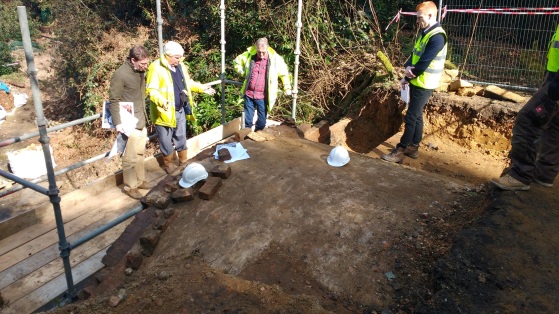
At the Hope Mausoleum the Friends donned their hard hats and high vis vests and spent time digging out the remains of the walls of the Mausoleum under the supervision of the Stone Masons PAYE. Their hard work helped reveal which elements of the stone work could be rescued and the extent of the walls that needed to be rebuilt.

The repairs to the Mausoleum are being carried out by PAYE, expert stone masons, on the advice we received from English Heritage to ensure the last surviving building by Thomas Hope is sensitively restored.

Chart Park

The Mausoleum sits nestled in the historic Chart Park – now mostly occupied by Dorking Golf Course. There are some areas around the Mausoleum however that the volunteers have been working hard to clear of brush and debris so that it can eventually return to grassland and wildflowers as it was in the early 19th century.

Chart park
Chart Park

Betchworth Castle

Further afield at the Eastern edge of the new Deepdene Trail lies the dramatic ruins of Betchworth Castle. Here at the end of last year the volunteers joined Castle owner, Martin Higgins, in moving young Yew trees growing on the slopes of the hill up to line the terrace around the Castle joining some ancient yews that still remained. This will strengthen the terrace which when the Trail is open will form part of a circuit of the Castle.

FoD volunteers at Betchworth 9.12.15
Volunteers at Betchworth Castle
Betchworth Castle 9.12.15
Betchworth Castle

Deepdene Gardens

mosaic stone_ Deepdene Gardens find_13.1.16  (1)
Mosaic Stone found in Deepdene Gardens

A major part of the Friends’ work has been in the heart of the Trail at Deepdene Gardens. The Gardens are still closed to the public as major works go on to repair key architectural features and open up the historic paths into the site for new visitors. The Friends have been working hard to open up these paths, cutting back the overgrown rhododendrons, digging out tricky tree stumps, even undertaking minor tree works with volunteers trained in using the chainsaw and bow-saw.


This fantastic transformation even uncovered an unusual stone find which is currently with Dorking Museum and we look forward to seeing if we can uncover more about which part of the life of this great estate it is linked to.

Join us!

Would you like to join the Friends on site and get involved in work like this? They currently work two days every week (Wednesday-Thursday) but we are looking at doing the occasional Saturday once the better weather sets in. If you are interested in conserving this fantastic historic landscape, looking for a bit of regular exercise or are a dab hand with a pair of secateurs and willing to lend a hand, we would be delighted to hear from you. Please contact:

thedeepdenetrail@molevalley.gov.uk

Find out more on the Friends’ website.